Materials+ML Workshop Day 6

Content for today:
- Types of Machine Learning
- Supervised/Unsupervised/Reinforcement Learning
- Supervised Learning
- Model Validity
- Regression, Logistic Regression, Classification
- Train/validation/Test sets
- Training Supervised Learning Models
- Loss functions
- Gradient Descent (if time)
- Classification Problems (if time)
- Application: Classifying Perovskites
- Installing scikit-learn
- scikit-learn models
The Workshop Online Book:
https://cburdine.github.io/materials-ml-workshop/
- Recordings of Previous Workshop Sessions (and slides) now available!
Tentative Workshop Schedule:
| Session | Date | Content |
|---|---|---|
| Day 0 | 06/16/2023 (2:30-3:30 PM) | Introduction, Setting up your Python Notebook |
| Day 1 | 06/19/2023 (2:30-3:30 PM) | Python Data Types |
| Day 2 | 06/20/2023 (2:30-3:30 PM) | Python Functions and Classes |
| Day 3 | 06/21/2023 (2:30-3:30 PM) | Scientific Computing with Numpy and Scipy |
| Day 4 | 06/22/2023 (2:30-3:30 PM) | Data Manipulation and Visualization |
| Day 5 | 06/23/2023 (2:30-3:30 PM) | Materials Science Packages |
| Day 6 | 06/26/2023 (2:30-3:30 PM) | Introduction to ML, Supervised Learning |
| Day 7 | 06/27/2023 (2:30-3:30 PM) | Regression Models |
| Day 8 | 06/28/2023 (2:30-3:30 PM) | Unsupervised Learning |
| Day 9 | 06/29/2023 (2:30-3:30 PM) | Neural Networks |
| Day 10 | 06/30/2023 (2:30-3:30 PM) | Advanced Applications in Materials Science |
Questions about review material:
- Intro to ML Content:
- Statistics Review
- Linear Algebra Review
Machine Learning
What is Machine Learning?
Machine Learning (ML) is a subfield of AI (Artificial Intelligence), that is concerned with:
- Developing computational models that make predictions, identify trends, etc.
- Methods that can be applied to improve these models based on data
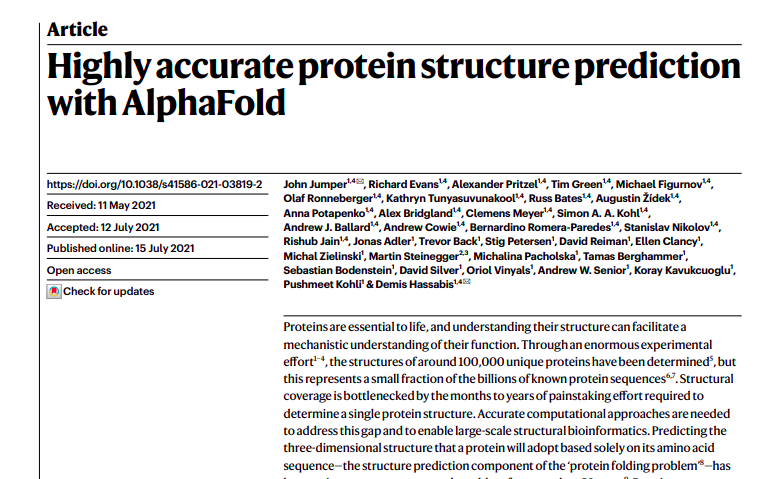
Google DeepMind's Alphafold (2021)
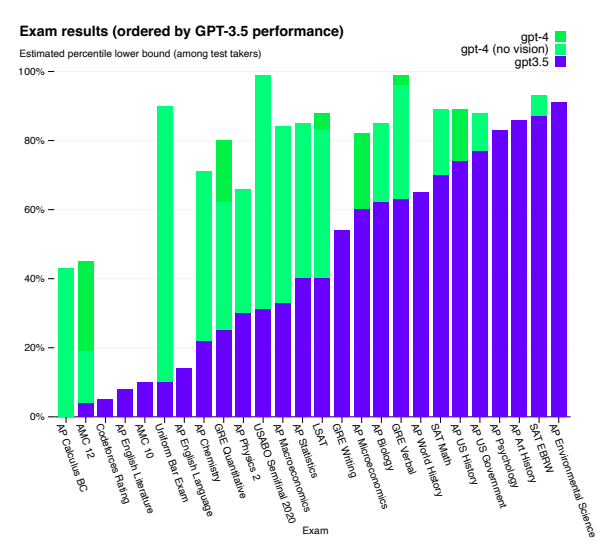
OpenAI's ChatGPT and GPT-4 Models (2023):
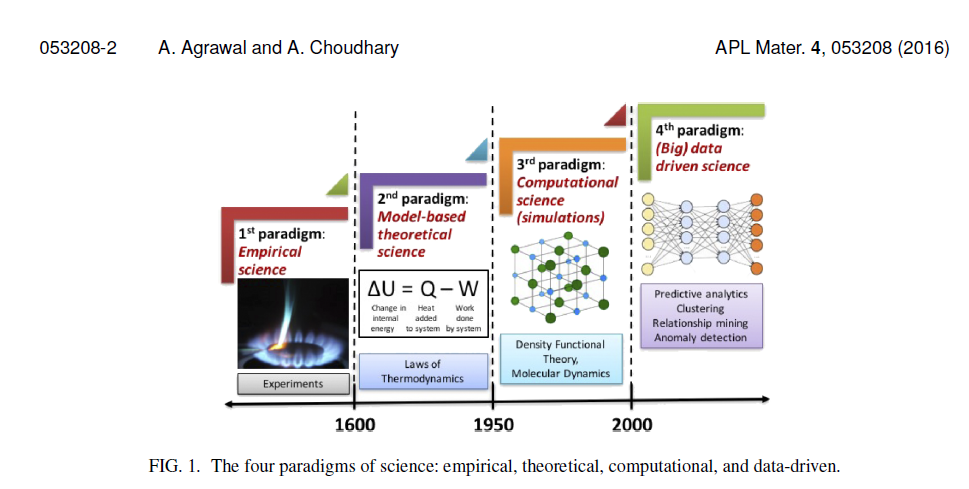
ML in Materials Science:
Types of Machine Learning Problems
Machine Learning Problems can be divided into three general categories:
- Supervised Learning: A predictive model is provided with a labeled dataset with the goal of making predictions based on these labeled examples
- Examples: regression, classification
- Unsupervised Learning: A model is applied to unlabeled data with the goal of discovering trends, patterns, extracting features, or finding relationships between data.
- Examples: clustering, dimensionality reduction, anomaly detection
- Reinforcement Learning: An agent learns to interact with an environment in order to maximize its cumulative rewards.
- Examples: intelligent control, game-playing, sequential design
Supervised Learning
When can supervised learning be applied?
Problems where the available data contains many different labeled examples
Problems that involve finding a model that maps a set of features (inputs) to labels (outputs).
A supervised learning dataset consists of $(\mathbf{x}, y)$ pairs:
- $\mathbf{x}$ is a vector of features (model inputs)
- $y$ is a label to be predicted (the model output)
$y$ values can be continuous scalars, vectors, or discrete classes.
Here, we will assume $\mathbf{x}$ is a real vector and $y$ is a continuous real scalar (unless otherwise specficied).
What is the goal of supervised Learning?
The goal is to learn a model that makes accurate predictions (denoted $\hat{y}$) of $y$ based on a vector of features $\mathbf{x}$.
We can think of a model as a function $f : \mathcal{X} \rightarrow \mathcal{Y}$
- $\mathcal{X}$ is the space of all possible feature vectors $\mathbf{x}$
- $\mathcal{Y}$ is the space of all labels $y$.

Types of Supervised Learning Problems:
The type of a supervised learning problem depends on the type of value $y$ we are attempting to predict:
If $y$ is a continuous value, it is a regression problem
If $y$ can be a finite number of values, it is a classification problem
If $y$ is a continuous probability (between $0$ and $1$), it is a logistic regression problem*
*In some textbooks, logistic regression also refers to a specific kind of model that is used for predicting probabilities.
Model Validity
- A model $f: \mathcal{X} \rightarrow \mathcal{Y}$ is valid if it approximately maps every set of features in $\mathcal{X}$ to the correct label $\mathcal{Y}$:
- This must hold for every label $y$ associated with every possible feature vector $\mathbf{x}$ in $\mathcal{X}$.
Model validity is a subjective property, because we may not know what the correct label $y$ is for every single value $\mathbf{x}$ in $\mathcal{X}$.
- Example: classifying images of cats vs. dogs

Often, we only know the $(\mathbf{x},y)$ pairs in our dataset.
If there is noise or bias in our data, even those $(\mathbf{x},y)$ pairs may be unreliable.
- Even if a model fits the dataset perfectly, we may not know if the fit is valid, because we don't know the $(\mathbf{x},y)$ pairs that lie outside the training dataset:

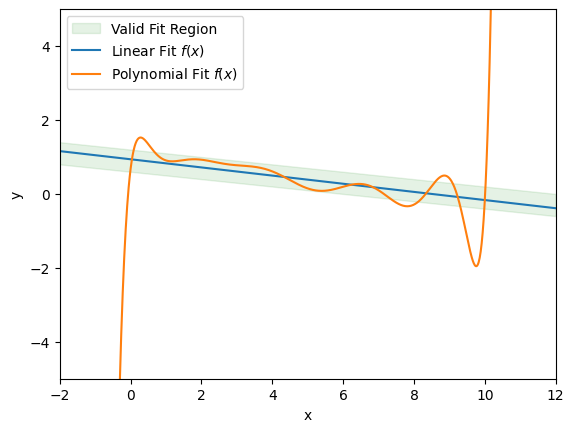
Choosing between two models:
- Consider the following two models fit to the same dataset:
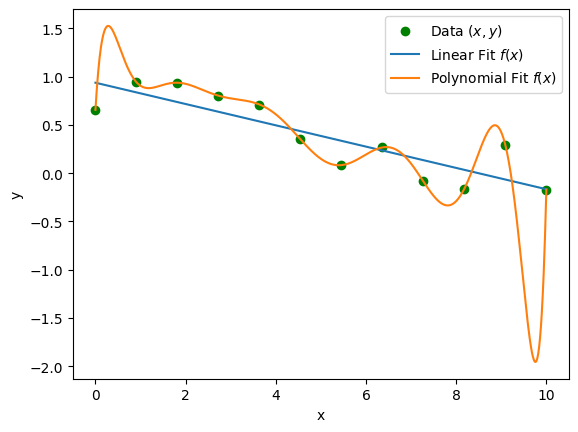
Which model is the more valid model?
- Even though the polynomial perfectly fits the data, it is not valid because it extrapolates poorly:
Estimating Validity:
Here's how we can solve the problem of estimating model validity:
Purposely leave out a random subset of the data that the model is fit to.
- Use that subset to evaluate the accuracy of the fitted model.
This subset that we leave out is called the validation set.
The subset we fit the model to is called the training set.
Traning Validation, and Test Sets:
- Common practice is to set aside 10% of the data as the validation set.
- In some problems another 10% of the data is set aside as the test set.

Validation vs. Test Sets:
The validation set is used for comparing the accuracy of different models or instances of the same model with different parameters.
The test set is used to provide a final, unbiased estimate of the best model selected using the validation set.
Evaluating the final model accuracy on the test set eliminates selection bias associated with the accuracies on the validation set.
The more models that are compared using the validation set, the greater the need for the test set.
This is especially true if you are reporting the statistical significance of your model's accuracy being better than another model.
Preparing Data:
For each feature vector $\mathbf{x}$, some features vary much more than other features.
To avoid making our model more sensitive to features with high variance, we normalize each feature, so that it lies roughly on the interval $[-2,2]$.
- Normalization is a transformation $\mathbf{x} \mapsto \mathbf{z}$:
- $\mu_i$ and $\sigma_i$ are the mean and standard deviation of the $i$th feature in the training dataset.
Loss functions:
To evaluate the accuracy of a model on a dataset, we use a loss function.
A loss function is function of a prediction $\hat{y}$ and a true label $y$ that increases as the prediction deviates from the true label.
- Example (square error loss):
- A good loss function should attain its minimum when $\hat{y} = y$.
Model Loss Functions:
- We can evaluate how well a model $f$ fits a dataset $\{(\mathbf{x}_i, y_i)\}_{i=1}^N$ by taking the average of a loss function evaluated on all $(\mathbf{x}_i, y_i)$ pairs.
Examples:
Mean Square Error (MSE):
$$\mathcal{E}(f) = \frac{1}{N} \sum_{n=1}^N (f(\mathbf{x}_n) - y_n)^2$$
Mean Absolute Error (MAE):
$$\mathcal{E}(f) = \frac{1}{N} \sum_{n=1}^N |f(\mathbf{x}_n) - y_n|$$
Classification Accuracy:
$$\mathcal{E}(f) = \frac{1}{N} \sum_{n=1}^N \delta(\hat{y} - y) = \left[ \frac{\text{# Correct}}{\text{Total}} \right]$$
Fitting Models to Data:
Most models have weights that must be adjusted to fit the training dataset:
Example (1D polynomial regression):
$$f(x) = \sum_{d=0}^{D} w_dx^d$$
There are many different methods that can be used to find the optimial weights $w_i$.
The most common method for fitting the data is through gradient descent.
- Gradient descent makes iterative adjustments to weight values such that each adjustment decreases the model loss $\mathcal{E}(f)$.
Some models (such as linear regression) have optimal weights that can be solved for in closed form.
Gradient Descent
- Gradient descent makes iterative adjustments to the model weights $\mathbf{w}$:

Review: The Gradient
The gradient of a function $g: \mathbb{R}^n \rightarrow \mathbb{R}$ is the vector-valued function:
$$\nabla g(\mathbf{w}) = \begin{bmatrix} \frac{\partial g}{\partial w_0}(\mathbf{w}) & \frac{\partial g}{\partial w_1}(\mathbf{w}) & \dots & \frac{\partial g}{\partial w_n}(\mathbf{w}) \end{bmatrix}^T$$- ($\nabla g(\mathbf{w})$ is a function $\mathbb{R}^n \rightarrow \mathbb{R}^n$)
- The gradient at a point $\mathbf{w}$ "points" in the direction in which $g$ increases the most.
Tutorial: Classifying Perovskites
- We will work with some basic classification models that classify perovskite materials as "cubic" or "non-cubic".
Recommended Reading:
- Advanced Regression Models
If possible, try to do the exercises. Bring your questions to our next meeting (next Monday).